Korean restaurant basics
한국 식당의 기본
A handful of conventions explain most of what surprises people at a Korean table.
The little dishes
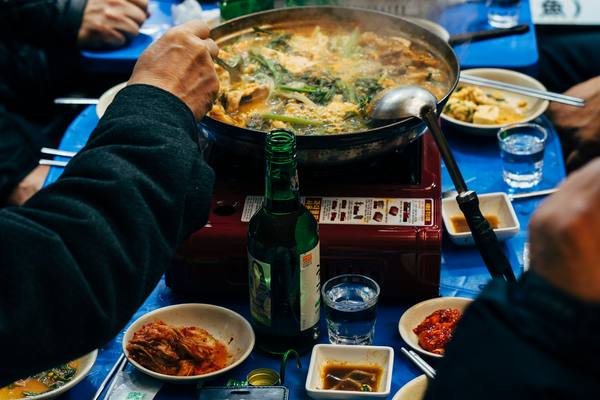
Side dishes often arrive unordered with the meal, and at many places they are not charged separately and you can ask for more. They are meant to be eaten alongside the main dish rather than as a starter, so pace yourself.
At many places everything comes out at once rather than in courses.
Some dishes are sold for two
Some dishes, often barbecue and stews, have a minimum of two portions, so a solo diner may be told no. It is not rudeness. Some restaurants will do a single portion if you ask, and others have counter seats set up for eating alone.
The break
Some restaurants close in the middle of the afternoon and reopen for dinner. There is often a last order time as well, before the posted closing time. Both are why you can arrive at a place that is open according to the internet and find the lights off, so check the hours we show and arrive with time to spare.
Getting attention
Many tables have a call button. Press it. Where there is none, calling out to staff is common. Water and cutlery are often self serve from a station or a drawer under the table.
Paying
At many places you pay at the counter on the way out rather than at the table, as one bill for the table. No tip, see “Nobody expects a tip”.
Phrases to show staff
Show the Korean line on your phone, or say it aloud: the spelling in brackets reads like English.
- ___ 알레르기가 있어요. 빼주실 수 있나요?
- I am allergic to ___. Could you leave it out?
- ___ allereugiga isseoyo. Ppaejusil su innayo? (___ ahl-leh-reu-gee-gah ee-ssuh-yoh. ppeh-joo-sheel ssoo een-nah-yoh?)
- 이 음식에 돼지고기나 술이 들어가나요?
- Does this dish contain pork or alcohol?
- I eumsige dwaejigogina suri deureoganayo? (ee eum-shee-geh dweh-jee-goh-gee-nah soo-ree deu-ruh-gah-nah-yoh?)
- 이 음식에 밀가루가 들어가나요?
- Does this dish contain wheat flour?
- I eumsige milgaruga deureoganayo? (ee eum-shee-geh meel-kkah-roo-gah deu-ruh-gah-nah-yoh?)
- 얼마나 기다려야 할까요?
- How long will I have to wait?
- Eolmana gidaryeoya halkkayo? (uhl-mah-nah gee-dah-ryuh-yah hahl-kkah-yoh?)